The Artist’s Statement Is Not a Secret Code
Learn how to read an artist’s statement for its claims about process, purpose, and context, while keeping clear what the artwork itself leaves open.
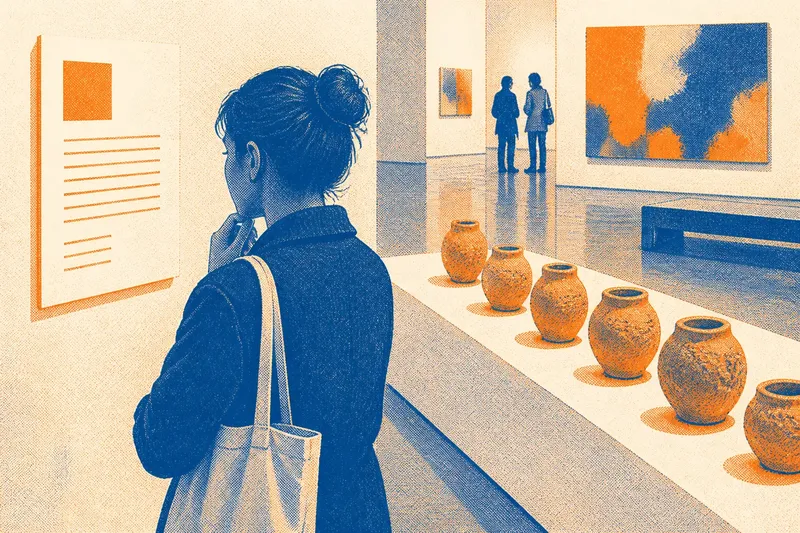
You’re beside a wall text when the artist’s statement names a memory, a political concern, or a process you can’t see. Reading an artist’s statement is less like finding a caption for the work and more like hearing the maker describe a set of choices.
That distinction matters because statements speak from a particular position: the artist’s. They can explain what prompted a work, what decisions shaped it, or what the artist hopes viewers will consider. They can’t supply every detail about how the work was made, and they don’t need to settle every question it raises.
An artist’s statement describes a position, not a verdict
A statement may tell you that an artist began with a family photograph, worked with salvaged wood, or wanted to examine public memory. Those details are claims about the work’s origins and aims. They are different from the visible or audible features you can point to directly.
Keep those kinds of information distinct. If the statement says the artist arranged objects to suggest a kitchen table, the arrangement and materials are observable; the intended association comes from the artist’s account. You can consider both without treating either as a complete explanation.
Separate the artist’s claims from the work’s evidence
It helps to ask what kind of sentence you’re reading. A statement might describe a process, name a concern, explain a decision, or propose a way to approach the work. Each offers a different kind of context, and none needs to function as a symbol-by-symbol decoding key.
- Process: If the artist describes sewing discarded fabric, look for seams, repairs, and changes in texture; if those features aren’t visible, treat the sentence as information about how it was made rather than a visual clue.
- Purpose: If the artist names a concern such as migration, consider which details might connect to that concern; if the connection remains unclear, keep the stated aim in mind without forcing it onto every element.
- Influence: If the statement names a place, tradition, or earlier work, check whether the exhibition provides more context; if it doesn’t, avoid assuming you know the full relationship.
- Invitation: If the artist suggests attending to sound or movement, notice what happens in the work; if that prompt doesn’t change your response, you can set it aside.
- Omission: If a statement leaves out a collaborator or local history you want to understand, look for a catalog, audio guide, or other exhibition text; if none is available, leave the question open rather than filling the gap with guesswork.
- Audience response: If your reaction differs from the artist’s description, name the feature that shaped your response; if the statement still seems relevant, hold both accounts together instead of choosing one as the only valid reading.
Translate specialized language into useful questions
Statements sometimes use terms such as archive, materiality, or collective memory. You don’t have to master every term before engaging with the work. Ask what the word refers to in this particular statement: a collection of documents, the qualities of a substance, or a shared account of the past.
Then connect the term to a choice the artist describes. If the statement mentions an archive, for example, it may help to notice whether the work includes documents, labels, or repeated images. If you can’t make that connection, the term can remain unresolved; your attention to form, sound, or placement is still available.
A worked reading can keep intention and observation distinct
Imagine you’re looking at a row of small clay vessels. The following details are invented: the statement says the artist made them in response to domestic routines, and you can see that each vessel has a similar shape but a different rough surface.
First, identify the artist’s claim: the work responds to domestic routines. Next, name the observable choices: repeated vessel forms and varied surfaces. Then consider a possible connection: repetition may suggest recurring tasks, while the surface differences draw attention to individual handling. The result is a reading that uses the statement without pretending it explains every mark or dictates what you must feel.
How should you read an artist’s statement?
Should I read the statement before looking at the work?
Either order can serve a different purpose. Looking first gives you a chance to form your own questions, while reading first may point out a process or context you might not have noticed.
Does an artist’s intention determine what a work means?
The statement can clarify the artist’s aims, but the work also has features viewers can encounter directly. A reading can take the artist’s account seriously while acknowledging details or responses the statement doesn’t address.
What should I do with unfamiliar terms?
Use the surrounding sentences to infer what the artist means in context, then connect the term to a described material, choice, or concern. If the meaning stays unclear, you can continue without treating the vocabulary as a prerequisite.
Where can I find context the statement leaves out?
Check the exhibition’s wall labels, catalog, or audio guide for other accounts and background. If those sources aren’t available, recognize the limit of the statement rather than inventing an explanation for what it omits.
Keep the statement in its proper frame
To read an artist’s statement well, distinguish what the artist says they intended from what you can observe and what you infer. That small habit makes room for process, purpose, and context without asking one short text to carry the whole work.
As you leave, remember one specific claim from the statement and one question it leaves unanswered. The unanswered question can be useful: it points you back to the work, or toward another source, without turning uncertainty into a failure to understand.